If you’re traveling with CPAP therapy, you don’t have to skip a week of treatment or lug your full-size machine through security. For a smooth trip, here’s what matters.
Do you need a separate travel machine?
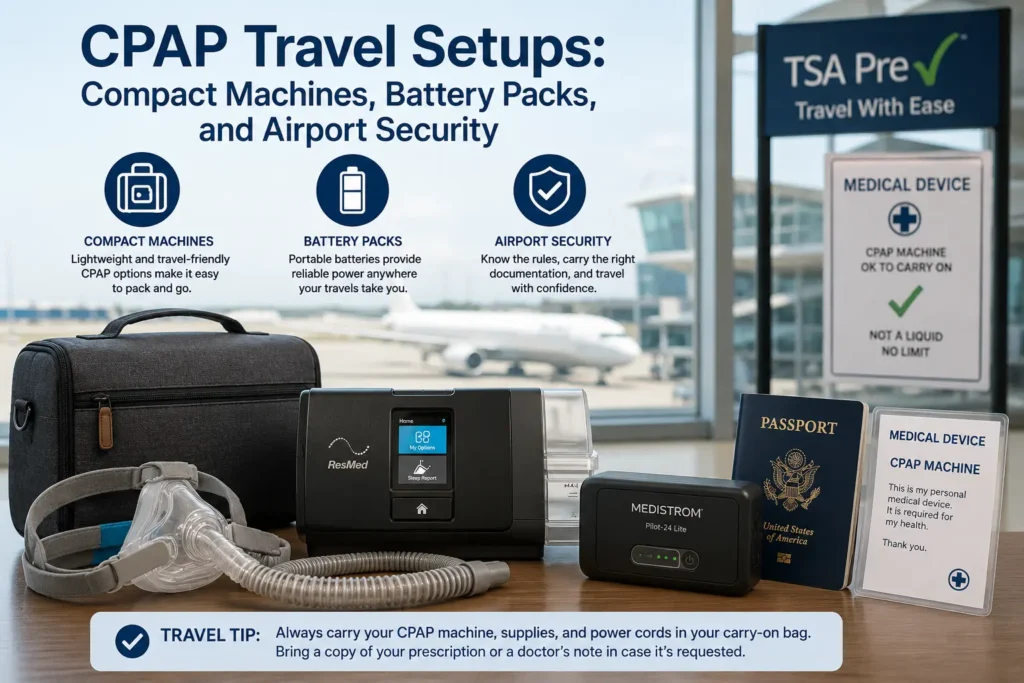
Not necessarily. Most standard CPAP and APAP machines are small enough to travel with, and airlines are legally required to let you bring a CPAP machine as a medical device — it does not count against your carry-on limit.
That said, a dedicated travel machine makes sense if you:
- Travel frequently, especially by air
- Camp or spend time somewhere without reliable outlet access
- Want a battery-friendly option that skips the bulky heated humidifier for short trips
- Are trying to minimize luggage weight for backpacking or multi-leg trip
Travel-specific machines are typically a third to half the size and weight of standard models, though this usually comes with trade-offs — a smaller or absent humidifier, proprietary mask connectors, and a higher price per unit compared to standard machines.
Battery packs: what actually gets you through the night
If you’re going somewhere without steady power — camping, a long flight, a region with unreliable electricity — a battery pack is the difference between using therapy and skipping it.
A few things to check before buying one:
- Runtime, not just capacity. Battery capacity is usually listed in watt-hours, but actual runtime depends heavily on your pressure setting and whether you’re running a humidifier (which draws significantly more power). A battery rated for “two nights” without humidifier use might only get you one night with it running.
- Compatibility. Not all batteries work with all machines — check that the battery is rated for your specific model, not just “universal” CPAP compatibility.
- Charging time. If you’re moving between locations daily, a battery that takes 6+ hours to recharge may not keep pace with your trip.
For most casual travelers, a battery covering one to two nights without humidifier use is enough backup for flight delays or unexpected outages. Frequent campers or off-grid travelers usually want a higher-capacity option they can pair with a portable solar charger.
What actually clears airport security
CPAP machines are allowed as carry-on medical equipment and don’t count toward your bag limit, but a few practical points make the process smoother:
- Declare it. Tell the TSA officer (or equivalent at other airports) that you have a CPAP machine before screening starts. It typically gets swabbed for explosive residue rather than fully unpacked.
- Keep it out of your checked bag. Checked luggage handling isn’t gentle, and losing a checked bag means losing your therapy for the trip. Carry it on.
- Distilled water is usually fine in small quantities, but rules vary by country — if you’re using a humidifier, it’s simpler to empty the water chamber before security and refill after, or plan to buy distilled water at your destination.
- A letter from your doctor isn’t required in most countries, but some travelers keep one anyway in case of questions, especially for international travel.
Packing tips that prevent problems
Bring your original mask and cushion, plus a spare cushion if you have one — cushions are the part most likely to tear or lose their seal mid-trip.
A travel case with a padded liner protects the machine from being crushed under other carry-on items.
If you’re changing time zones significantly, don’t worry about adjusting your pressure settings — they’re based on your airway, not your schedule.
The bottom line
You don’t need to choose between travel and treatment. A standard machine works for most short trips, a dedicated travel unit earns its cost with frequent flying or off-grid trips, and a properly sized battery pack is the real safety net when power isn’t guaranteed. The biggest single fix most travelers need: declare the machine at security and keep it in your carry-on, always.
This article is for educational purposes only and isn’t a substitute for guidance from your prescribing physician or DME provider.