It can be difficult to understand the machine isolate if you have just been diagnosed with sleep apnea. There are three acronyms, one prescription, and a lot of confusing marketing to go with CPAP, BiPAP, and APAP. Let’s take a closer look at what separates them, and how to choose one that’s right for you.
CPAP: the standard starting point
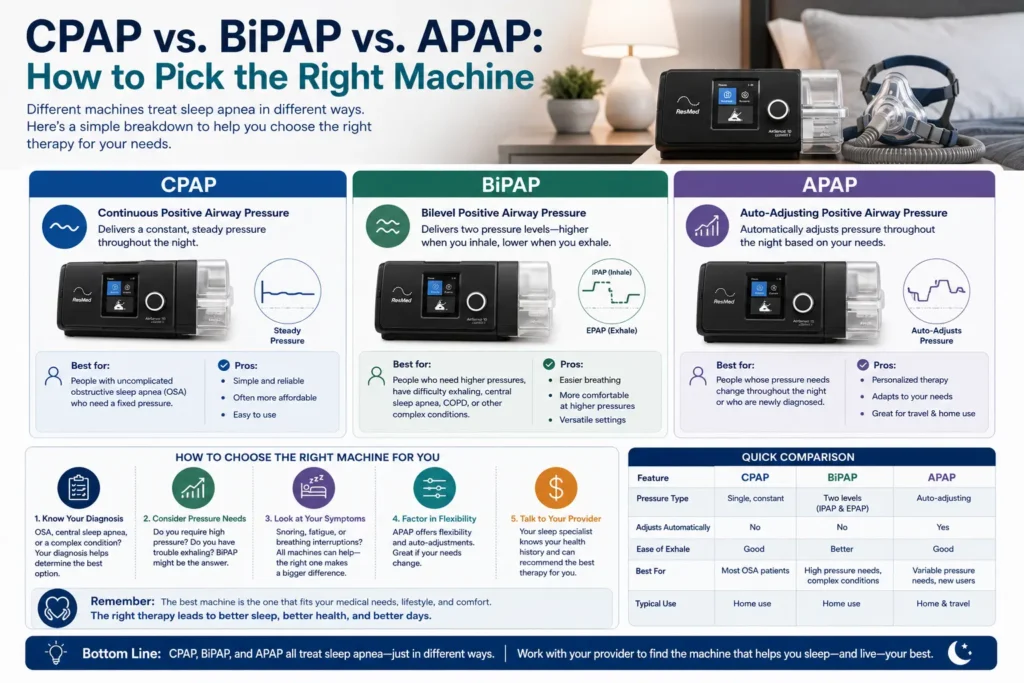
A CPAP (Continuous Positive Airway Pressure) machine delivers one fixed air pressure all night, keeping your airway open so it doesn’t collapse while you sleep. It’s the most commonly prescribed device for obstructive sleep apnea, and for most people with mild to moderate OSA, it’s the first machine they’ll ever use.
The upside is simplicity — one pressure setting, fewer variables, and generally the lowest cost of the three. The downside is that a fixed pressure doesn’t adjust as your body shifts positions, moves through sleep stages, or has an occasional restless night. Some people find the constant pressure takes getting used to, especially when exhaling against it.
APAP: pressure that adapts to you
An APAP (Auto-adjusting Positive Airway Pressure) machine senses resistance in your airway breath by breath and adjusts pressure up or down in real time. Instead of one number all night, it works within a range your doctor sets — lower when you don’t need much support, higher when you do.
This tends to suit people whose apnea severity changes with sleep position, alcohol intake, congestion, or weight fluctuations. It’s also a common choice for people who found a fixed CPAP pressure uncomfortable. Many modern “CPAP machines,” including some of the most popular models on the market, are technically APAP-capable and can run in either mode depending on how your provider configures them.
BiPAP: two pressures, for more complex cases
A BiPAP (Bilevel Positive Airway Pressure) machine uses two pressure settings — a higher one for inhaling and a lower one for exhaling. This makes breathing out against the airflow noticeably easier, which matters for people who struggle with a single high pressure.
BiPAP is typically prescribed for more complex situations: severe OSA that needs higher pressures than a standard CPAP comfortably delivers, central sleep apnea, or coexisting conditions like COPD where breathing support needs to be more nuanced. It’s rarely a first-line device — most people are moved to BiPAP after CPAP or APAP hasn’t worked well enough.
Matching the machine to your prescription
Here’s the part that trips people up: you can’t simply choose a machine type based on preference. Your prescription specifies a pressure range and, often, a device type based on your sleep study results. Buying an APAP when you’re prescribed a fixed CPAP pressure isn’t necessarily wrong — many APAP machines can be set to run at a single fixed pressure — but a BiPAP prescription for central sleep apnea or complex breathing patterns isn’t something a standard CPAP or APAP can substitute for.
If you’re unsure which category your prescription falls into, the pressure settings on your sleep study report or DME (durable medical equipment) order are the clearest signal. A single number (e.g., “10 cm H2O”) usually points to CPAP. A range (e.g., “8–14 cm H2O”) points to APAP. Two separate numbers for inhale and exhale point to BiPAP.
What actually matters day to day
Beyond the acronym, a few practical factors decide whether you’ll actually stick with therapy:
- Noise level — worth checking if you share a bed.
- Humidifier integration — built-in heated humidifiers reduce dryness and irritation significantly compared to add-on units.
- App and data tracking — most modern machines sync usage data to an app, which helps you and your clinician spot leaks, low usage nights, or pressure issues early.
- Ramp features — a gradual pressure increase at the start of the night can make falling asleep easier, especially in the first few weeks.
The bottom line
CPAP is the default for straightforward obstructive sleep apnea. APAP adds flexibility for variable needs and is often the more comfortable everyday choice. BiPAP is reserved for more complex or severe cases where a single pressure isn’t enough. The right one for you isn’t a matter of picking the “best” machine — it’s the one that matches what your sleep study actually found.
This article is for educational purposes only and isn’t a substitute for guidance from your prescribing physician or DME provider.