More people quit CPAP therapy because of a bad mask than because of a bad machine. The pressure settings might be perfect, but if the mask leaks, digs into your face, or doesn’t match how you actually sleep, none of that matters. Here’s how to narrow down the right style before you buy.
Start with your sleep position
This is the single biggest factor most people overlook.
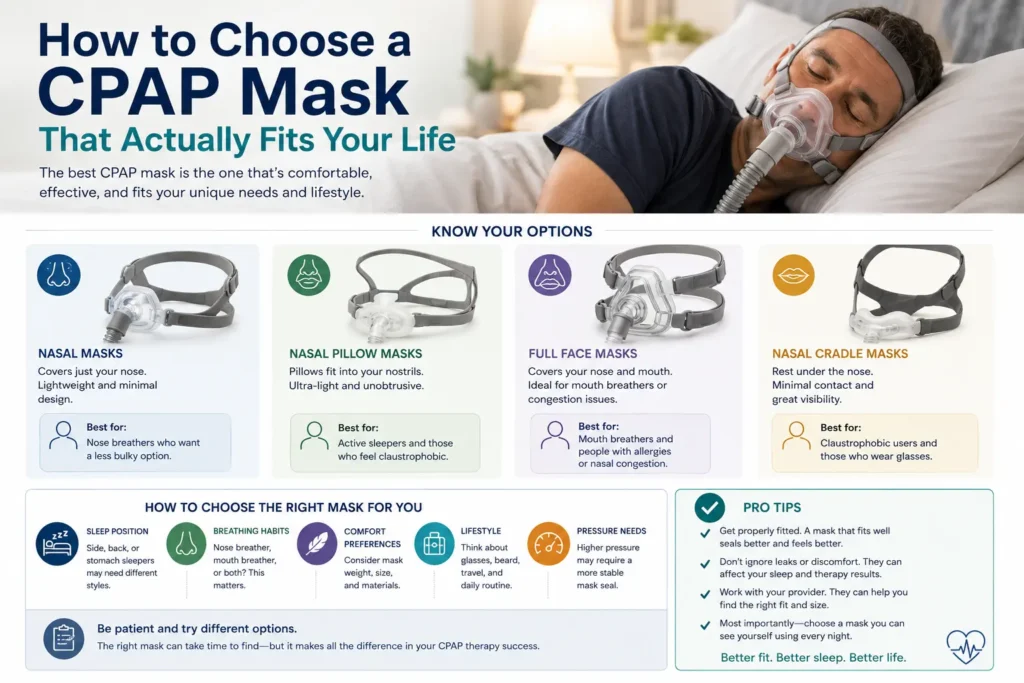
- Back sleepers have the most flexibility — nearly every mask style works reasonably well.
- Side sleepers usually do better with a low-profile nasal mask or nasal pillow, since bulkier full-face frames tend to get pushed sideways and break the seal against a pillow.
- Stomach sleepers need the smallest possible profile — nasal pillows are typically the only style that doesn’t get crushed or knocked loose face-down.
If you switch positions throughout the night, prioritize a mask with a swivel tube connector and a low-profile design over one that only works well in a single position.
Match the mask to how you breathe
This matters more than most people expect when they’re first prescribed therapy.
- Nasal breathers (people who naturally breathe through their nose, mouth closed) do well with nasal masks or nasal pillows — smaller, lighter, and less prone to feeling claustrophobic.
- Mouth breathers, or anyone who tends to sleep with their mouth open, generally need either a full-face mask or a nasal mask paired with a chin strap to prevent air from escaping through the mouth and undoing the pressure therapy entirely.
- If you’re not sure which category you fall into, ask a partner, or check the box for morning dry mouth — a strong sign air is escaping overnight.
Consider your face shape
Manufacturers design cushions around a handful of common face shapes, and most brands offer a fit-finder tool or printable sizing template before you buy.
- Broader faces or facial hair around the seal line often do better with memory-foam cushions, which mold slightly rather than relying on a rigid silicone seal.
- Smaller or narrower faces tend to have more luck with compact frame masks (like nasal pillow styles), which have fewer contact points to leak from in the first place.
- If you wear glasses and plan to read in bed, an under-the-nose or nasal pillow design keeps the frame clear of your line of sight.
The three main styles, briefly
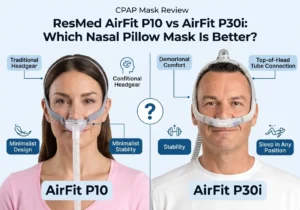
- Nasal pillows — small silicone inserts that sit just at the nostrils. Least intrusive, best field of vision, good for side and stomach sleepers, but not ideal for mouth breathers or very high pressure settings.
- Nasal masks — cover the nose only, sitting over the bridge and around the nostrils. A middle ground: more stable seal than pillows, less bulky than full-face.
- Full-face masks — cover both nose and mouth. Best for mouth breathers, higher pressure prescriptions, or anyone who gets nasal congestion easily, but bulkier and with more surface area that can leak if the fit isn’t right.
Fit is a process, not a purchase
Even the “right” mask style rarely feels perfect on night one. Straps typically need loosening, not tightening, to fix a leak — over-tightening usually pushes the cushion out of shape rather than sealing it better. Most manufacturers also offer multiple cushion sizes within the same mask model, so if the frame feels right but the seal doesn’t, a different cushion size is often the fix before switching styles entirely.
If you’re testing a new mask, give it at least a week of consistent use before deciding it’s wrong — the skin and habit of sleeping with something on your face both take time to adjust.
The bottom line
Choosing a mask isn’t about picking the most popular or highest-rated option — it’s about matching sleep position, breathing pattern, and face shape to a style built for that combination. Get those three right, and the rest is usually just minor strap adjustments.
This article is for educational purposes only and isn’t a substitute for guidance from your prescribing physician or DME provider.